
Useful
- Annual report
- Accessibility statement (Norwegian)
- Invoice information for business contacts (PDF)
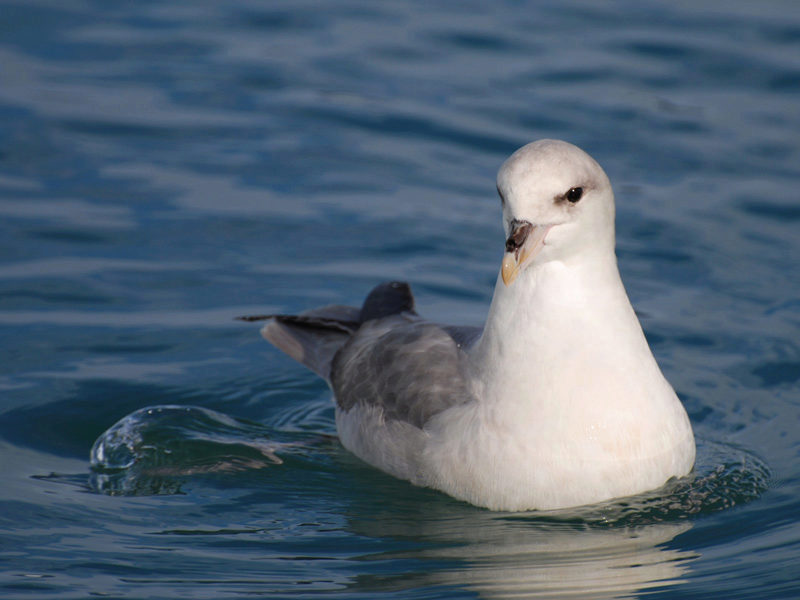
The northern fulmar (Fulmarus glacialis) has a relatively short and thick neck and large head. The bill is chunky with round, tube-like nostrils. Northern fulmars breed within the North Atlantic region, from Newfoundland in the southwest, to Svalbard and Novaya Zemlya in the north, and northern France in the southeast. The species also breeds in the North Pacific region, in Alaska and eastern Russia. It is the only species in the order Procellariiformes that breeds in Svalbard.
Contents
The northern fulmar is the only species in the order Procellariiformes that breeds in Svalbard. It is a stocky petrel that has a length of 45–53 cm and a weight of 650–1000 g; it has a relatively short, thick neck and large head.
Fulmars occur in two main colour morphs. The dark morph is predominant in the Svalbard area, while the light morph is common in more southern areas of the North Atlantic. The dark morph has a uniform grey-brown head, neck and under-parts, with darker upper-parts. In all of its colour varieties there is a light patch of feathers on the upper-side of the wings. The sexes are very similar, with only small differences in bill morphology making the sexes distinctive. The bill is chunky, and as in other procellariiformes, has round tube-like nostrils on top.
Two fulmar subspecies are recognised in the Atlantic region. F. g. glacialis in the high-Arctic (including Svalbard) and F. g. auduboni in low-Arctic and boreal areas, but they are often difficult to distinguish from one another based upon size or colour criteria.
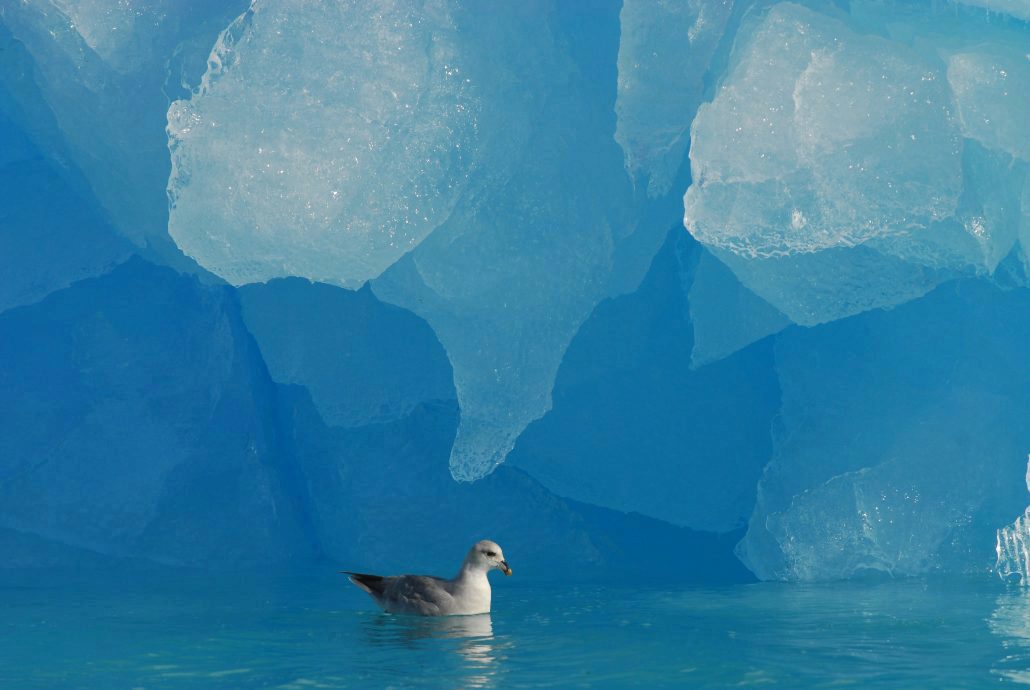
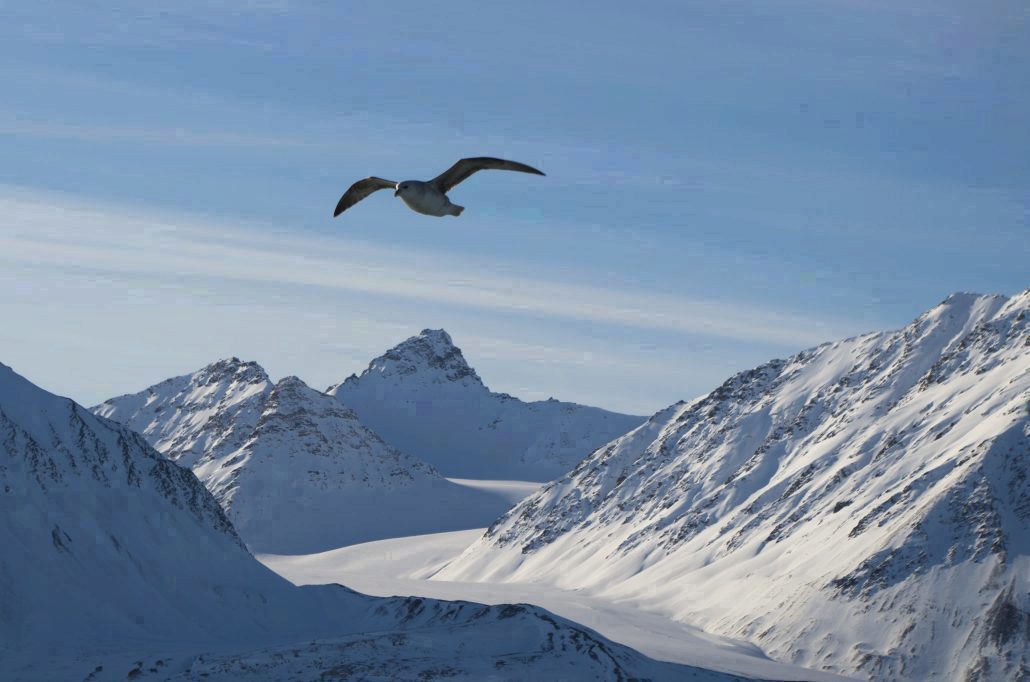
Fulmars glide over the sea just above the surface on stiff, straight wings, only giving a series of shallow, rapid wing beats now and then. They float high in the water when swimming and need a pattering run on the water surface in order to take off. Cackling and grunting calls are emitted at the nesting site; in flight fulmars are usually silent.
Northern fulmars breed within the North Atlantic region, from Newfoundland in the southwest, to Svalbard and Novaya Zemlya in the north, and northern France in the southeast. The species also breeds in the North Pacific region, in Alaska and eastern Russia.
Two fulmar subspecies are recognised in the Atlantic region — F. g. glacialis in the high-Arctic (including Svalbard) and F. g. auduboni in low-Arctic and boreal areas. But, they are often difficult to distinguish from one another based upon size or colour criteria.
In Svalbard, the northern fulmar breeds on coastal cliffs and on nunataks (small areas of exposed rock on the peaks of mountains). Breeding sites are distributed over most of the archipelago, but are scarce in the northeast. In total, 125 colonies are registered. Outside the breeding season, northern fulmars have a very pelagic life-style, roaming over large areas of ocean in search for food. This species can be observed in Svalbard from first light (they arrive in late winter, long before egg-laying commences) until the end of November or early December.
Northern European fulmars spend the winter in the North Atlantic, while the arctic breeding birds probably spend the winter months a little to the south of their breeding areas.
The northern fulmar breeds in loose colonies on narrow ledges on steep, inaccessible cliffs along the coast and on nunataks. Some colonies are large and dense, while others are quite scattered. Fulmar often have their nests on cliffs dominated by other species. But, in some places, e.g. Bjørnøya, they build nests on flat skerries or even in burrows on inaccessible slopes. Breeding birds exhibit strong fidelity to their nesting place, which is often visited outside the breeding period.
The northern fulmar is primarily a pelagic species which remains far out at sea except during the breeding season. Even during breeding it sometimes performes long forage trips. Fulmars breeding on Bjørnøya are known to feed in the central Barents Sea as well as along the coast of Northern Norway during the chick-rearing period.
They feed on small pelagic animals near the sea surface; in Svalbard they feed mainly on squid, polychaetes, pteropods, crustaceans and small fish. Capelin Mallotus villosus is the primary prey species for birds breeding at Bjørnøya. In the Arctic, the fulmar can be seen both in open sea areas and in ice-filled waters.
It is the seabird species that can be encountered farthest north in the drift-ice of the Arctic Ocean.
The northern fulmar is a long-lived species with a low reproductive rate.
In Svalbard, the single egg is generally laid during the latter half of May in a depression in the ground or directly on rock. The parents share incubating duties for about 50 days.
The chick has soft greyish down; it remains in the nest for about seven weeks before it is fledged. During the first two weeks after hatching one of the parents always remains close to the nest, but after this time both parents forage, returning intermittently to feed and warm the chick.
Fulmar chicks actively defend themselves against intruders, spitting an oily gastric juice on them with remarkable accuracy.
Similar to other petrels, fulmars reach sexual maturity late (normally after eight to nine years). However, the death rate among adults is very low (less than 5 % per year), and as a result northern fulmars can live to a very old age (60+), although the oldest individual recorded in Norway (including Svalbard) is 26 years.
The northern fulmar is one of Svalbard’s most numerous seabirds, but because they are difficult to census no detailed estimate of their population size is available. However, the breeding population is thought to exceed half a million breeding pairs.
Monitoring of the breeding population on Bjørnøya, and at one site on Spitsbergen since 1988, suggests that numbers are stable, but there is high inter-annual variation in the number of breeding pairs.
The boreal and low-Arctic population of the eastern North-Atlantic has been spreading and increasing in number for more than 200 years. The cause of this long-term increase in the northern fulmar population is not clear, but may be related to accidental human provisioning of these birds, first in the form of whale remains during periods of intensive commercial whaling and later by offal from offshore fishing trawlers. Fulmars are ‘professional’ boat-followers.

 Arctic tern