
Useful
- Annual report
- Accessibility statement (Norwegian)
- Invoice information for business contacts (PDF)

The purple sandpiper (Calidris maritima) is a stocky wader that breeds in the north-eastern parts of Arctic Canada, in Greenland, Iceland, the Faroes, Svalbard, in Northern Scandinavia and the western parts of the Russian Arctic. It has a dark brown plumage and an elongate, slightly downcurved, bill. It is a very hardy bird that does not migrate as far south during winter as most of the other small waders.
Contents
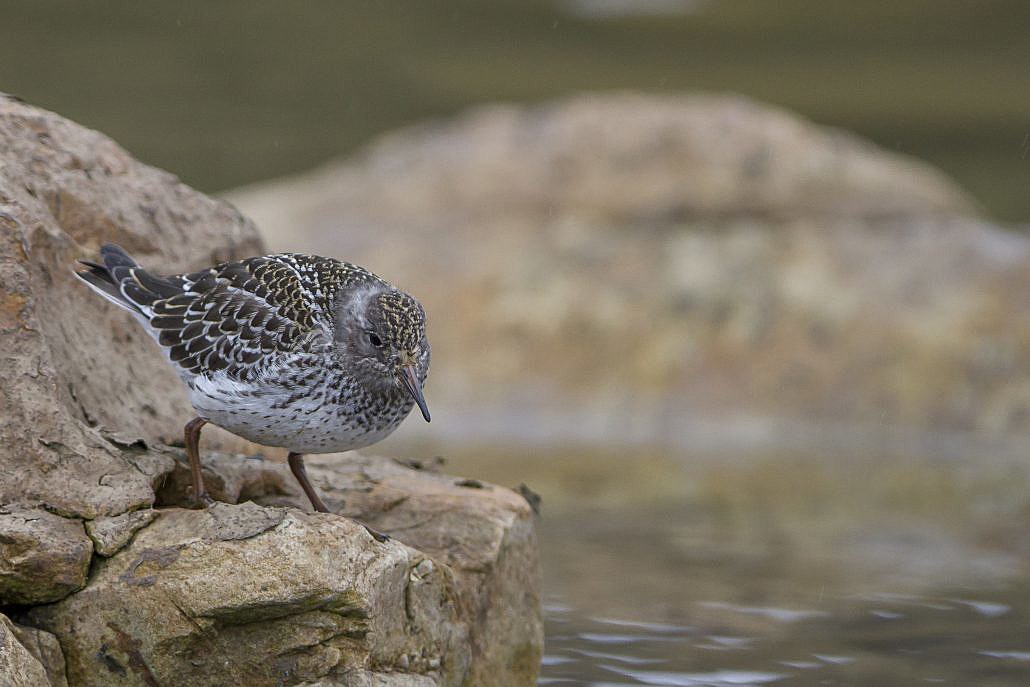
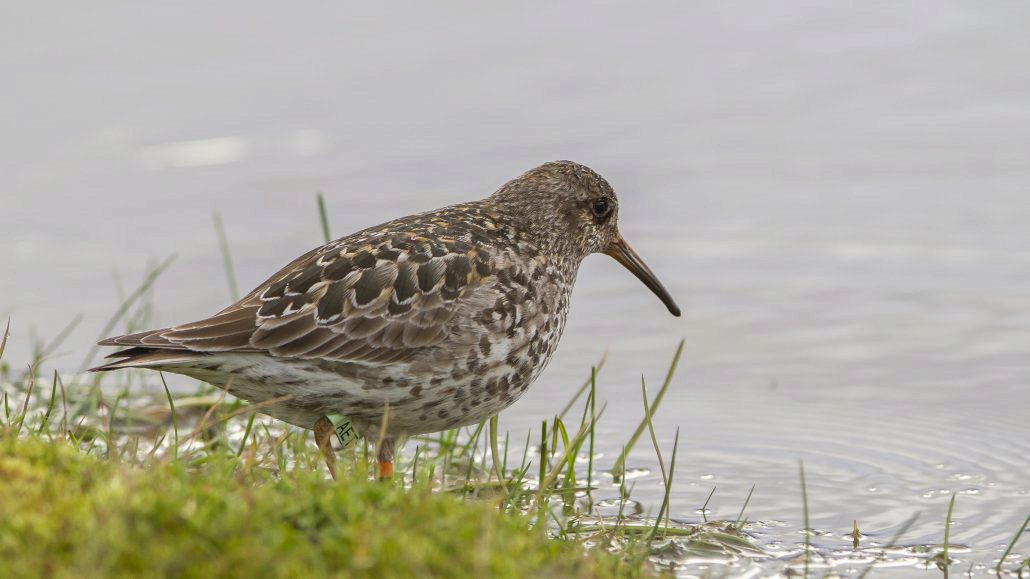
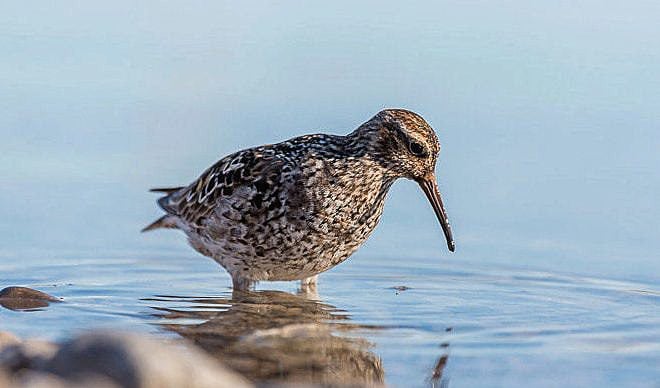
The purple sandpiper is a stocky wader with dark brown plumage and an elongate, slightly downcurved, bill that is about 3 cm long.
The sexes are similar in appearance. Adult birds are about 21 cm long and weigh 60–100 grams.
In summer the plumage is grey-black on the back with rusty-red and yellow-brown edges on the feathers; the breast is outlined in brown and the belly is white. A white wing bar is visible when the bird is in flight. The bill is dark brown, but often has a yellowish base. The legs are yellow-green. In winter plumage it is dark, sooty grey and less speckled, with a distinctive white eye ring and chin. Juveniles resemble the adults in winter plumage, though they have yellow-brown feather tips on the upper-parts.
A distinguishing feature of the species when seen standing or running, is that it often stretches out and lifts one of the wings up into the air. The call is a trilling ‘treeree-ree-reey’.
The purple sandpiper breeds in the north-eastern parts of Arctic Canada, in Greenland, Iceland, the Faroes, Svalbard, in Northern Scandinavia and the western parts of the Russian Arctic. In the North Pacific it is replaced by a similar species, the rock sandpiper C. ptilocnemis.
The purple sandpiper is the most common wader in Svalbard. It breeds on relatively dry tundra areas over most of the archipelago. Studies conducted in the large valleys in central Spitsbergen have suggested a breeding density of one pair per square kilometre. Purple sandpipers arrive quite early in the spring during the first half of May. They appear in groups of 50–100 individuals on mud-flats and in the intertidal zone, where they feed on small crustaceans, insects and other small invertebrates before dispersing in pairs out over the tundra to breed.
Purple sandpipers gather in groups along the coast before migrating southward in late August and September. The Svalbard population winters along the west coast of northwest Europe, including Great Britain. It is a hardy bird that does not migrate as far south during the winter as most other small waders.
In the breeding season purple sandpipers occur both near the coast and in the highlands. They occupy areas of tundra vegetation, areas near ponds and lakes and in addition spend time in the tidal zone along the coast. Outside the breeding period purple sandpipers occur more often along exposed rocky shores, where they forage in the intertidal zone.
The purple sandpiper has a very variable diet during the breeding season, but sustains itself predominantly with small crustaceans, insects, spiders and some vegetative matter.
Purple sandpipers nest as solitary pairs. The nest is placed in dry moss and lichen; it is bowl-shaped and finely lined with willow leaves and lichen.
The four pear-shaped eggs are olive-brown with dark brown speckles and blotches. The eggs are incubated for 21–22 days by both sexes, though probably mostly by the male. It is almost impossible to see an incubating bird on the nest, owing to the camouflage colouring of the plumage. The young leave the nest immediately after hatching and are reared by the male until they fledge after about three weeks.
The young feed on insects and spiders that they find on the tundra. The highest age recorded in Norway (including Svalbard) is ten years.
The size of the breeding population in Svalbard has been estimated to be between 2000 to 4000 pairs. However, no reliable census of the breeding population has been conducted. The European breeding population is estimated to be 75,000 pairs, and is regarded as being stable. The purple sandpiper is easily approached and it can be studied in detail while it goes about searching for food on the tundra or in tidal areas.
The arctic fox is an important predator of eggs and young. There is evidence to suggest that it is easier for foxes to locate nests that have been visited by humans. The fox probably follows scent trails left by people.
Hekkebestandens størrelse på Svalbard er beregnet til å ligge et sted mellom 2000 og 10 000 par. Det har ikke vært foretatt noen grundig kartlegging av bestanden, og arten inngår ikke i noe overvåkingsprogram. Den europeiske bestanden har tilsynelatende vært relativt stabil siden 1970, og den er trolig i størrelsesorden 75 000 par.
Fjæreplytten er relativt lite sky, og den kan studeres på nært hold når den søker næring på tundraen eller i fjæresonen.
 Pilot whale