Useful
- Annual report
- Accessibility statement (Norwegian)
- Invoice information for business contacts (PDF)
The Svalbard rock ptarmigan is the only land-inhabiting bird which resides in the archipelago throughout the year. It is a sub-species of the rock ptarmigan (Lagopus muta), and it is larger and heavier than either the rock ptarmigan or the willow ptarmigan on mainland Norway. The rock ptarmigan has a circumpolar distribution in northern temperate and arctic regions, in addition to the Alps and the Pyrenees. The sub-species L. m. hyperboreus is restricted to Svalbard and Franz Josef Land.
Contents
The Svalbard rock ptarmigan is a sub-species of rock ptarmigan (Lagopus muta), and it is larger and heavier than either the rock ptarmigan or the willow ptarmigan on mainland Norway.
Adult birds are 35–40 cm long and weigh between 490 and 1200 g. There is significant seasonal variation in body mass.
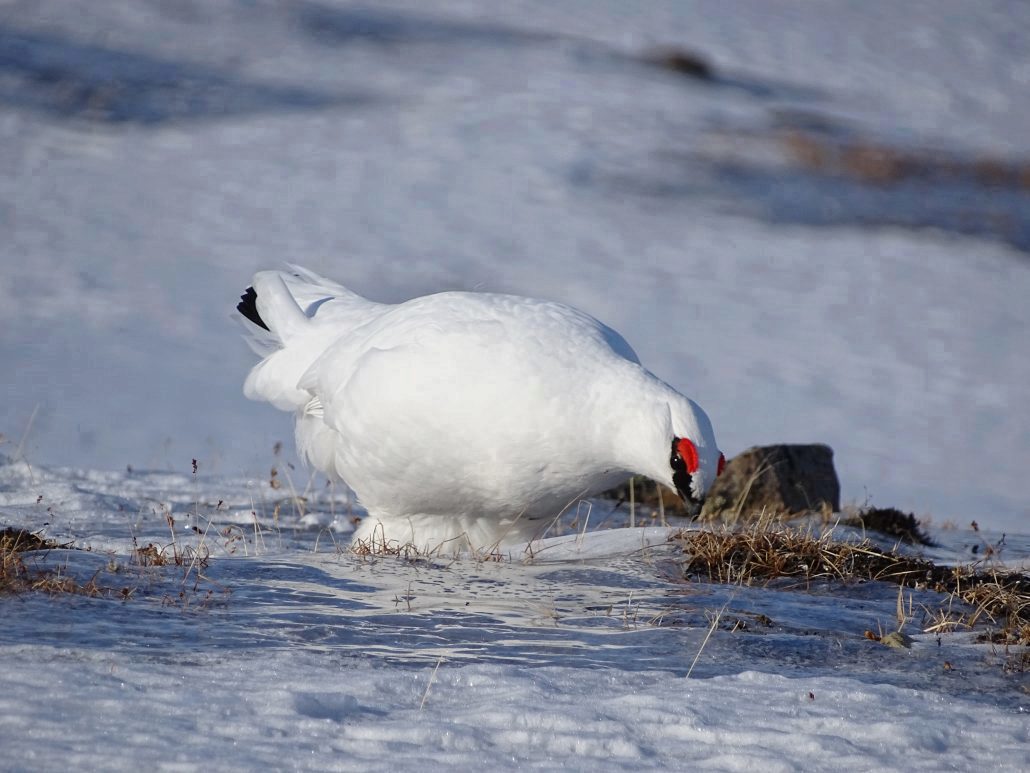
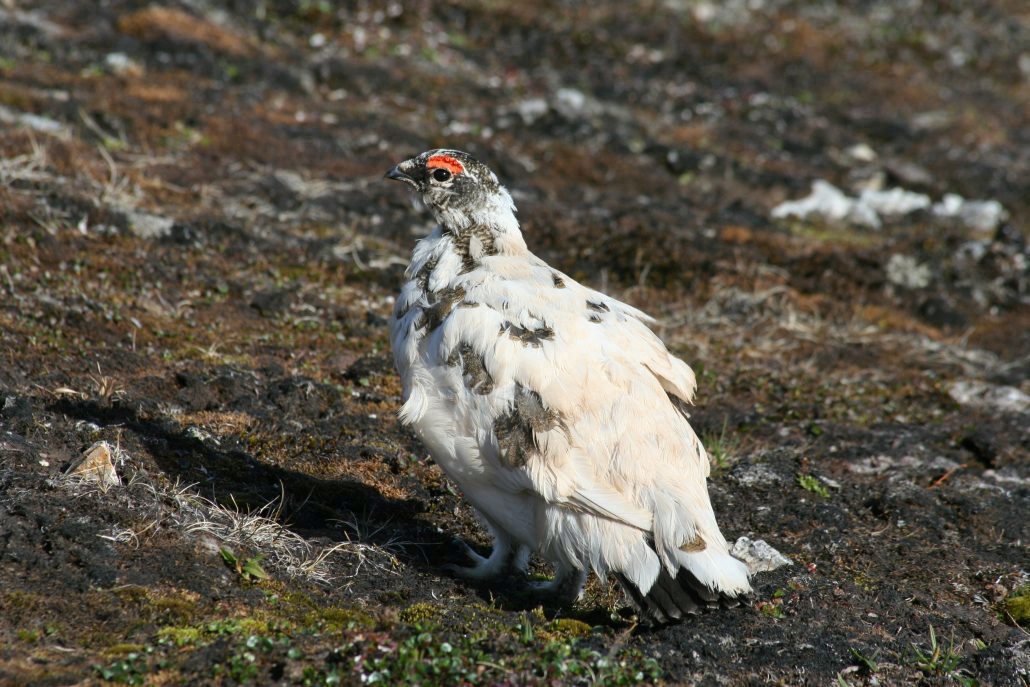
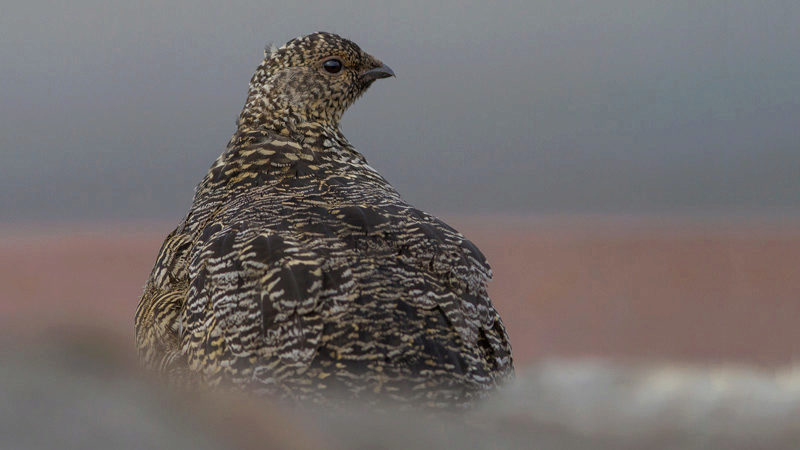
Both sexes have white winter plumage except for black outer tail feathers. The male (cock) has a black line from eye to the beak, and in the breeding season also a large, fleshy red comb above the eye. The female (hen) also has a red coloured stripe above the eye, but it is less visible. The hen changes into summer plumage in April-May. The feathers are more red-brown than the Scandinavian rock ptarmigan. The cock retains the white plumage until July and acquires the complete brown summer plumage in mid-August. By the end of September both sexes are again in winter plumage. Juvenile birds are more grey-brown than their parents and they have a brown tail.
The cock´s call is a characteristic burping ‘aarr-aa-ka-ka’, while the hen makes a more quiet call that sound like ‘kee-ah, kee-ah’.
The rock ptarmigan has a circumpolar distribution in alpine and arctic tundra regions, in addition to the Alps and the Pyrenees. The sub-species L. m. hyperborea is endemic to Svalbard and Franz Josef Land. The Svalbard rock ptarmigan is the only terrestrial bird residing in the archipelago throughout the year. It is common over most of Svalbard except for the most north-easterly parts of the island group; breeding has not been observed on Kvitøya, Kongs Karls Land, Hopen or Bjørnøya.
The Svalbard rock ptarmigan uses separate habitats in the winter compared to the breeding season. But, little is known about the location of the wintering areas or possible migration routes, though it is assumed that they seek relatively snow-free areas such as under bird-cliffs and other areas with rich vegetation. One pilot study using satellite telemetry indicates that the ptarmigan remain in the breeding area from spring until the start of the hunting season (10 September). In late September or early October the birds begin to make longer movements. The longest autumn migration documented covered a distance of more than 100 km and birds migrated both northward (to the west side of Wijdefjorden ca. 100 km) and south (to Hornsund ca. 110 km).
The cocks return to the breeding grounds round the end of March to establish and defend a territory that ranges in size from 3–50 hectare. The hens arrive in early April. Less than 3% of the land area in Spitsbergen constitutes medium to high quality breeding habitat. The best habitats are located on south-facing slopes where the snow melts early. Altitude, terrain ruggedness and vegetation characteristics are the most important landscape attributes determining the quality of the habitat for nesting. Territories in optimal areas (with many wind-blown ridges and abundant vegetation) are occupied first followed by sub-optimal and marginal territories. Cocks return to the same territory in subsequent years, whereas hens change territory (and partners) but always come back to the same general breeding grounds.
The Svalbard rock ptarmigan has low genetic diversity and appears to be isolated from other ptarmigan populations. The Svalbard rock ptarmigan lives in an exceptionally simple terrestrial food web, probably only representative for a few isolated high-arctic islands without small rodents and their associated guild of specialist predators.
The most important predators of the Svalbard ptarmigan are the arctic foxes, glaucous gulls and arctic skuas. Consistent with the lack of specialist predators, the Svalbard rock ptarmigan shows no population cycling, such as that seen in Scotland, Iceland and Alaska where there are 6–10 year cycles.
The diet of rock ptarmigan varies seasonally. Alpine bistort is the most important food source in summer and autumn. In late autumn and early winter various species of meadow-grasses and hair-grasses are important food plants. From November to February purple and tufted saxifrage are the main food source, while polar willow increases in the diet from March-April and is important for building fat reserves in the spring.
Mating takes place in late May. The nest is usually located in the upper part of the territory on dry ground and consists of a 1–2 cm deep scrape in the ground that is lined with dead leaves.
Egg-laying occurs in early to mid June, but may be delayed in years with late snow melting. Repeated egg-laying can occur if eggs are lost early in the season. There are usually 9–11 eggs in a nest (successive clutches contain fewer).
A cock can have more than one hen within his territory, but the second hen lays her clutch later than the first and produces fewer chicks. The eggs are yellow-brown with brown-black speckles and blotches. The eggs are incubated by the hen for 21 days and the hatching weight of chicks is about 16 g.
The hen and her brood leave the nest one to two days after hatching. Chicks are fledged after 10–12 days, but remain with their mother for 10–12 weeks. The pair bond between the adult male and female dissolves when the hen leaves the nest with the chicks. At this time the cock leaves the breeding site in order to find better foraging grounds. Ptarmigans become sexually mature during their first year of life (about 10 months).
Population estimates do not exist for the rock ptarmigan over the whole Svalbard Archipelago, but an annual monitoring programme established in 2000 has documented low and stable densities, with 1–3 males/km2 in the spring.
The Svalbard rock ptarmigan is the most popular small game species in terms of off take per year and the number of participating hunters. Hunting takes place annually from 10 September until 23 December and the annual harvest varies between 500 and 2300 birds. This level of hunting does not appear to represent any risk to this population.
However, climate change does have potential associated risks for Svalbard’s ptarmigans, one of them being the substantially increasing population of pink-footed geese that overlap in habitat use, and share key food plants with the ptarmigan, increasing the possibility for food competition. Additionally, temporal and spatial variability in predation rates in Svalbard rock ptarmigan may be caused by climate induced fluctuations in the abundance of alternative food sources for the arctic fox, such as reindeer carrion and breeding geese.

 Ruddy turnstone