
Useful
- Annual report
- Accessibility statement (Norwegian)
- Invoice information for business contacts (PDF)
The blue whale is the largest animal ever to have lived on earth. In the Northern Hemisphere blue whales are 24–28 meters long, can weigh up to 200 tonnes and produce a distinctive, high blow that can be up to 12 metres tall. The blue whale is found worldwide, ranging into all major oceans.
Contents
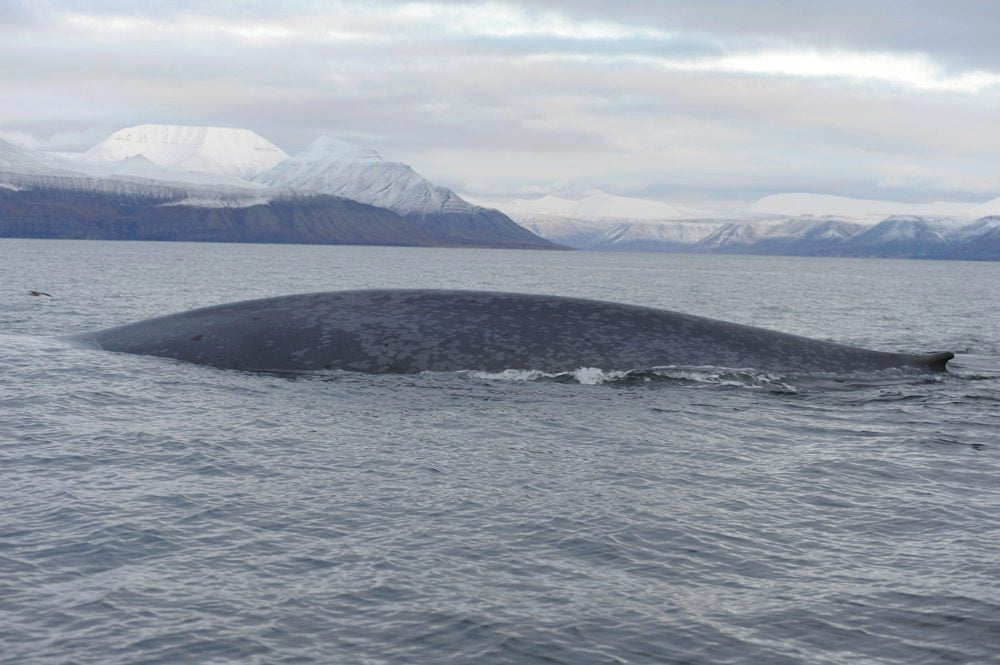
The blue whale is the largest animal ever to have lived on earth. Its mottled colouration, which is a mix of light and dark patches of slate grey, often appears to be various shades of blue when seen through the water. Some animals have distinct chevrons curving down their backs from the blowhole area, similar to fin whales, while others do not. Regardless of the patterning, blue whales generally appear lighter in colour than the other rorquals.
In the Northern Hemisphere blue whales are 24–28 metres long. They have a more tapered, elongate shape than other rorqual whales and a very broad, U-shaped head. The head has a prominent, fleshy ridge just in front of the blowhole that extends in a line forward to the upper jaw. Blue whales have 60–90 throat grooves. The dorsal fin of blue whales is proportionally smaller than in other rorqual whales and is located further back on the body than in the other members of this family. They produce a distinctive, high blow that can be up to 12 m tall.
Blue whales are most commonly observed alone or as pairs.
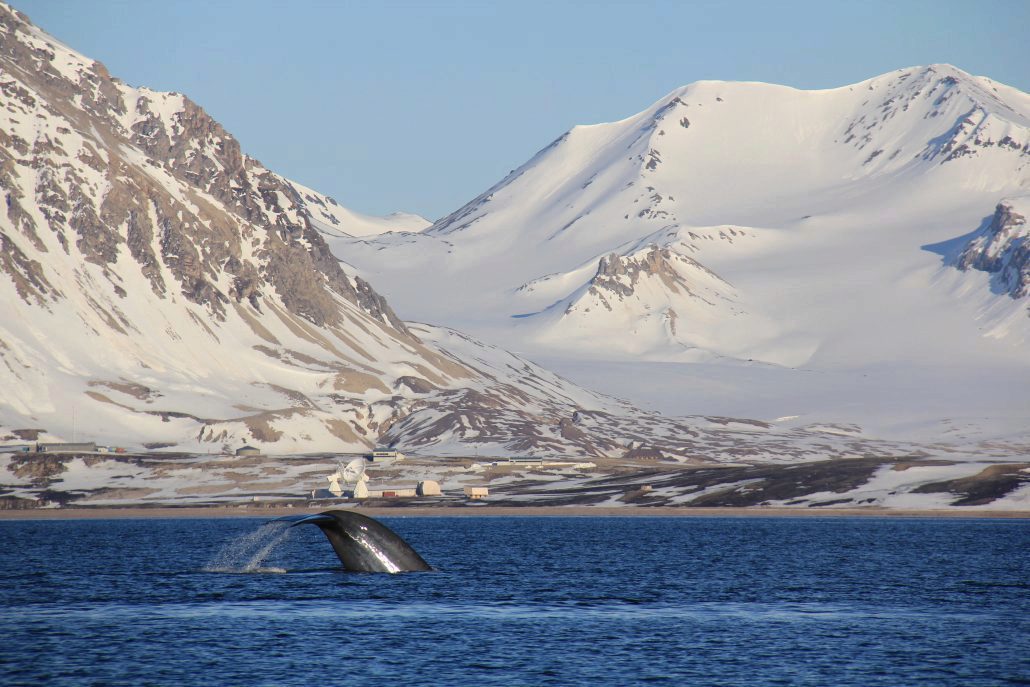
About 20% of blue whales in the North Atlantic show their fluke when they dive; it appears to be a trait of individual animals. The margin of the tail is usually fairly straight, dipping to a median notch.
The blue whale is found worldwide, ranging into all major oceans. Sightings are rare in the North Atlantic region, apart from reports from Iceland and the Azores. Blue whales are found as far north as Baffin Bayin the west and Spitsbergen in the east.
The migratory habits of the blue whale are not well known. They appear to spread across the Atlantic basin during the winter months, and may move north and south with the seasons, presumably travelling offshore as they are not sighted coastally.
Blue whales were taken to the brink of extinction by commercial whaling and they remain endangered. The global population size is not known, but it is likely that the number is somewhere near 6,000 animals. In the whole of the North Atlantic there are between 600 and 1,500 blue whales.
Blue whales are quite solitary, but occasionally they are seen travelling as pairs, and congregations do occur at feeding areas. They are a vocal species that produces a wide variety of low frequency or infrasonic sounds (undetectable by the human ear), so we may underestimate the degree of sociality that they maintain. The sounds they produce are certainly detectable hundreds of kilometres away from the source and under ideal conditions maybe thousands of kilometres away.
Blue whales usually cruise at three to six kilometres per hour, but can attain burst speeds of up to 30 km per hour. During the day they dive to about 100 m and swim through schools of krill. Their feeding dives at this time usually last 8–15 minutes, although dives up to 30 minutes are possible for them.
In the evening, they feed primarily near the surface, lunging up through schools of krill, or rolling across the surface with their mouths wide open. Similar to most other large baleen whales, blue whales seem to move into cold water areas for foraging in the summer and move to more temperate areas for wintering. The principle diet of blue whales is krill, and the distribution of this type of food largely determines where blue whales can be found.
Killer whales are the only known natural predator of blue whales.
Blue whales give birth in the winter months, following a 10-12 month gestation period. Mating takes place in the autumn. Calves measure six to seven metres in length when they are born. Mothers nurse their calves for about seven months.
Little is known about the reproductive behaviour of this species. Sexual maturity is reached at approximately 8–10 years of age and females give birth every two to three years thereafter.
The life expectancy of blue whales in not known, but it is likely that they live 80–90 years, perhaps even longer.
Blue whales were hunted to the brink of extinction. In excess of 10,000 animals were taken in the North Atlantic alone, and hundreds of thousands were taken in the Southern Ocean. The blue whale was protected worldwide in 1966, but the species remains endangered today.
There has been a notable increase in the number of reported sightings of this species in Svalbard; for example, in 2012 63 observations were reported from coastal waters. Undoubtedly, many of these sightings from various boats are reporting the same individuals. But, the North East Atlantic population of this species is increasing following the cessation of hunting some decades ago and the blue whale’s summer distribution is likely also shifting northward.

 Jon Aars / Norsk PolarinstituttArctic fox