
Useful
- Annual report
- Accessibility statement (Norwegian)
- Invoice information for business contacts (PDF)
The Brünnich’s guillemot is a stout, sturdily built auk that is slightly smaller than the common guillemot, and is one of the most numerous seabirds in the northern hemisphere. Brünnich’s guillemots from Svalbard generally winter in waters off Iceland, Greenland and Newfoundland (Canada), although many stay in the Barents Sea throughout the year.
Contents
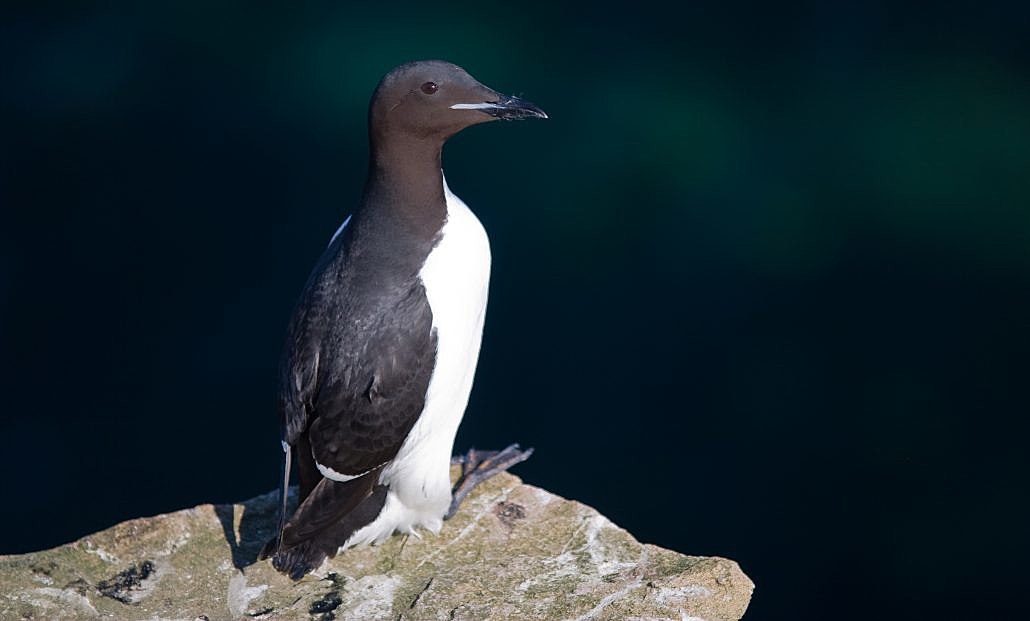
The Brünnich’s guillemot is a large black and white auk. Males and females are similar in appearance. Adult birds are approximately 41 cm long and weigh 700–1200 g.
The Brünnich’s guillemot is distinguishable from the common guillemot by their shorter and thicker bill, which has a white line along the sides of the upper mandible, and by the lack of dark mottling on the flanks.
In breeding plumage the head, neck and back are black, while the under-parts are white. The white breast forms a narrow wedge towards the dark fore-neck. In winter plumage the neck and throat are white, but contrary to the common guillemot, the darker colouring of the head extends well below the eye and down to the cheeks.
The juvenile resembles the adult in winter plumage, but the bill is smaller.
The most common vocalization at the nesting site is a growl, similar to that of common guillemots.
The Brünnich’s guillemot is one of the most numerous seabirds in the northern hemisphere. It has a high latitude circumpolar distribution in arctic and sub-arctic seas between 46 ºN and 82 ºN. In the northeast Atlantic, it breeds from Greenland, Iceland, Jan Mayen, Svalbard, Franz Josef Land and Novaya Zemlya. It does breed on mainland Norway in the north, but only in small numbers.
Four sub-species are recognized. The Svalbard population, and the rest of the birds in the North Atlantic, belong to the nominate race lomvia. The Brünnich’s guillemot is one of the most numerous seabirds in Svalbard; it breeds in dense colonies all over the archipelago. In total 142 colonies are known in Svalbard. The largest colonies (several over 100,000 pairs) are situated on the south-eastern parts of Spitsbergen (Koval’skijfjella and Stellingfjellet), Hopen and Bjørnøya.
More than 80 % of the Svalbard population breeds within this ‘triangle’. Brünnich’s guillemots from Spitsbergen generally winter in waters off southwest Greenland, Newfoundland and Labrador, whereas birds from Bjørnøya mainly winter around Iceland. Brünnich’s guillemots leave their colonies when the chick fledges towards the end of July or in the early August. They return to the colonies in April or May.
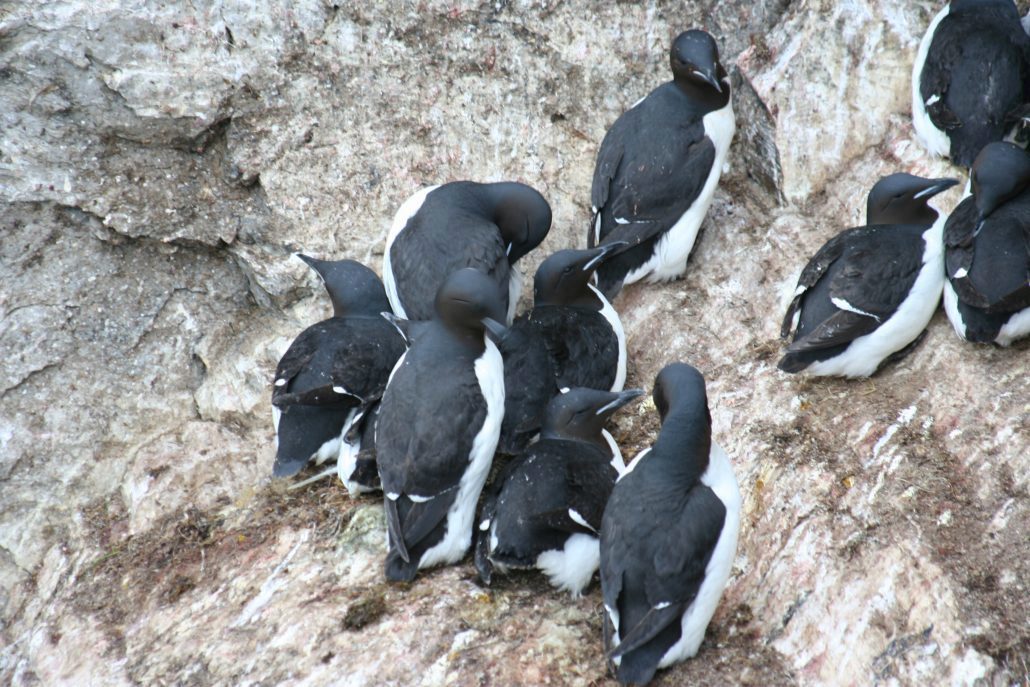
The Brünnich’s guillemot breeds on narrow cliff ledges in dense colonies that vary in size from some hundred pairs to several hundred thousand pairs. The colonies are usually situated on vertical cliffs at or near the sea shore. In Svalbard the Brünnich’s guillemot often breeds in mixed colonies with black-legged kittiwakes, and on Bjørnøya it mixes with the common guillemot. Outside the breeding season it appears in coastal waters and at sea, often in ice-filled areas.
The diet of adult Brünnich’s guillemots consists mainly of fish and crustaceans. On Spitsbergen, important prey items include polar cod Boreogadus saida, blennies (e.g. Lumpenus lampretaeformis and Leptoclinus maculatus) and capelin Mallotus villosus. On Bjørnøya, capelin is the most important prey item.
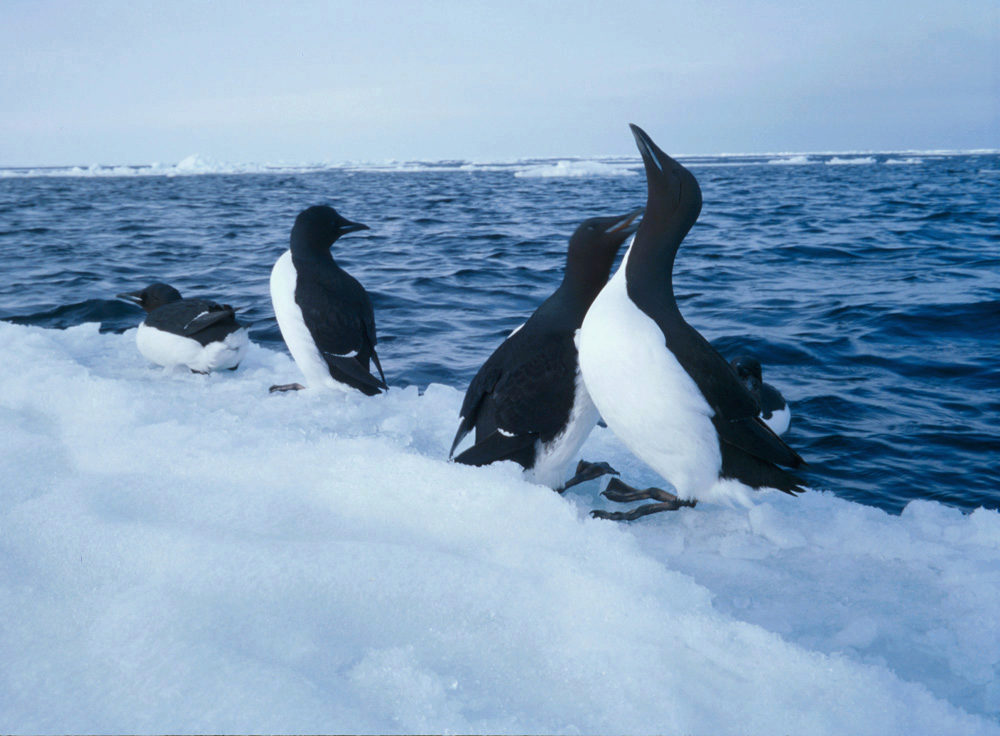
The chicks are mainly fed fish by their parents. In the spring, Brünnich’s guillemots are known to forage along the ice edge or in leads in the sea ice.
The arctic fox and the glaucous gull are important predators of eggs, chicks and sometimes adult birds.
The breeding biology of the Brünnich’s guillemot is similar to that of the common guillemot. Even though the breeding sites are occupied early in spring, egg-laying does not begin until the end of May or early June. The nesting ledges are usually narrower than those of the common guillemot, with room for only one row of incubating birds.
The females all lay eggs at about the same time, so that the timing of the hatching and the jumping of the young off the ledges is highly synchronized. The single egg is pear-shaped and quite variable in colour. It can be a light blue-green through to brown with dark lines and blotches. Both sexes incubate, and during incubation the birds lie with their breasts pointed in towards the cliff-face so that only their black backs are visible. The incubation period lasts for about 32 days. Like the common guillemot the young jump off the breeding ledges before they are fully fledged, when they are about 20–21 days old.
The chick is followed out to sea by one of its parents, usually the male. In colonies that lie some distance from the sea the young must walk between the cliff and the sea on land. They are highly vulnerable to predation from arctic fox and glaucous gulls during this trip. The adults and young undertake a swimming migration away from the breeding colonies towards the rearing and wintering areas. After leaving the colony the parents lose their ability to fly for some weeks while they moult into winter plumage. The young probably become independent six to eight weeks after leaving the nest.
The total breeding population in Svalbard is estimated to be 850,000 pairs. While the number of common guillemots breeding on Bjørnøya decreased drastically in 1986–87, the Brünnich’s guillemot on Bjørnøya increased by approximately 20 % in a years following 1986. The different population responses of these two species to the collapse of the capelin stock are probably due to the more varied diet of the Brünnich’s guillemot compared to the common guillemot. Since 1990 the population of Brünnich’s guillemots on Bjørnøya has been more or less stable.
In the rest of Svalbard a general increase in the population was recorded in several regions during the 1980s and the beginning of the 1990s. However, since 1995 the annual monitoring programme has shown a decrease in the size of the breeding population in all monitored colonies. This decline may be linked to changes in oceanographic conditions in the wintering areas.
Additionally, a considerable number of Svalbard-reared juveniles are shot in Greenland and Newfoundland outside the breeding period. However, hunting pressure (in Greenland) has declined since the early 2000s and studies of adult survival rates on Bjørnøya indicate that this winter hunt does not have significant impacts on the Svalbard population.

 Common guillemot